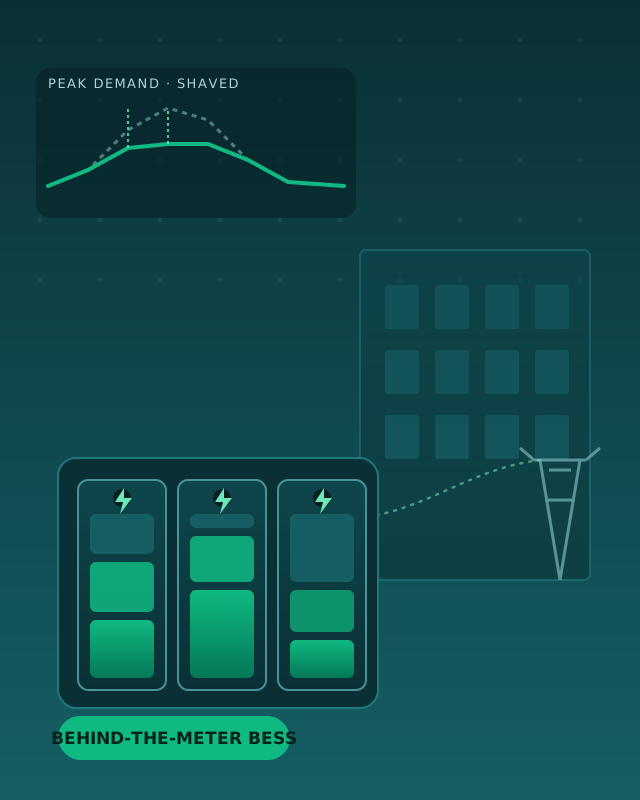
A battery energy storage system (BESS) stores electrical energy in rechargeable batteries and releases it when it is most valuable. For a UK business, a commercial BESS sits behind your meter and is controlled to do something a domestic battery never does: work the shape of a half-hourly commercial demand profile. This guide explains what a BESS is, what it is made of, how a commercial system actually works, and how the economics stack up in 2026 — written for the person who has to justify the spend, not for an encyclopedia.
What is a battery energy storage system?
At its simplest, a BESS is a box of batteries plus the electronics and software to charge and discharge them safely and intelligently. The phrase covers everything from a domestic wall battery to a 100 MWh grid-scale site, but the engineering principle is the same: convert grid or solar electricity into stored chemical energy, hold it, and convert it back to electricity on demand. What changes with scale is the control objective. A commercial battery energy storage system (roughly 50 kWh to 1 MWh) is optimised to reduce one business's energy costs and, increasingly, to earn that business an income from helping balance the grid.
The five parts of a commercial BESS
A complete behind-the-meter system is more than the cells. There are five building blocks, and a specialist designs all of them around your site:
- Battery modules — the cells that store the energy, almost always lithium iron phosphate (LFP) in commercial systems for thermal stability and cycle life.
- Power conversion system (PCS / inverter) — converts between the battery's DC and your site's AC, and sets how fast the system can charge or discharge (its power rating in kW).
- Battery management system (BMS) — monitors every cell's voltage, current and temperature, balances the pack, and is the first line of safety.
- Energy management system (EMS) — the software brain. It reads your half-hourly load and tariff and schedules charge/discharge to capture the most value, and bids the asset into grid markets where that applies.
- Enclosure, protection and thermal management — the cabinet or container, fire detection and (where designed) suppression, ventilation, switchgear and metering, all to the IET Code of Practice for Electrical Energy Storage Systems.
How a commercial battery energy storage system works
The mechanics are straightforward; the intelligence is in the timing. The system charges when electricity is cheap or surplus — overnight, during off-peak windows, or from your own solar when it is generating more than the site is using. It then discharges when electricity is expensive or demand peaks — typically the weekday late-afternoon peak when both unit rates and red-band DUoS distribution charges are highest. Because the EMS works from your actual demand shape, the same physical battery can do several jobs in a day: flatten the peak, capture the day/night price spread, soak up solar, and hold a reserve for backup. On larger systems it can also keep some capacity free to sell to the grid. This is the core difference from a domestic battery, which mostly just stores solar for evening use.
What a business uses a BESS for — the value streams
A commercial BESS rarely pays back on one saving. It "stacks" value, and which streams apply depends on your site:
- Peak shaving & demand management — cut red-band DUoS, peak unit rates, and available-capacity (kVA) charges.
- Energy arbitrage — charge on cheap off-peak power, discharge into the expensive peak.
- Solar-plus-storage — lift self-consumption from ~55% to 85%+, turning low-value export into avoided import.
- Backup power & resilience — ride through outages and reduce reliance on a diesel generator.
- EV fleet charging buffer — run rapid chargers behind a constrained connection without a grid upgrade.
- Grid services & revenue stacking — earn from the Capacity Market, frequency response, the Balancing Mechanism (via P415) and the Demand Flexibility Service.
Commercial, industrial and grid-scale: which is which
The terms overlap, so to be precise: commercial battery storage is behind-the-meter and sized to a single business — most often 50 kWh to 1 MWh. Industrial battery storage is the larger behind-the-meter end of that range, for manufacturers and energy-intensive sites, where peak-shaving and avoided grid reinforcement dominate the case. Grid-scale BESS is a different animal: many MWh, in front of the meter, owned to trade wholesale energy and balancing services. This site is about the first two — the systems a business installs on its own site to cut its own bill.
Sizing, cost and safety in brief
A commercial BESS is specified by two numbers: power (kW) and energy (kWh). A 250 kW / 500 kWh system is a "2-hour" battery. Installed cost in 2026 is roughly £200–£450/kWh, dropping towards £140–£240/kWh for larger containerised systems; the capital usually falls inside the £1m Annual Investment Allowance and is fully deducted in year one. On safety, the LFP chemistry, cell-level BMS, thermal management and IET Code of Practice design are what keep a commercial system well within insurer requirements. For the full numbers, see our cost and payback guide and funding and tax guide.
Where the value comes from in 2026
The commercial case for storage has shifted, and it is worth understanding why. The Triad regime ended and the network charging structure moved to a banded DUoS model, so the value is now in avoiding the red-band distribution half-hours (roughly weekday late afternoon) rather than three unpredictable winter peaks. On top of unit rates, a half-hourly business also carries non-commodity charges — DUoS, BSUoS, Capacity Market and other levies — and an available-capacity (kVA) charge. A battery attacks several of these at once by flattening the demand peak. That is why we always model from real consumption data: the saving is specific to your charging bands and load shape, not a headline percentage. See the peak shaving and energy arbitrage pages for the mechanics, and the grid services revenue page for how larger systems earn NESO frequency-response and Balancing Mechanism income on top.
Standards, safety and grid compliance
A commercial battery is a piece of electrical plant with its own regulatory stack, and a competent installer designs to all of it. It is one of the clearest ways to tell a specialist from a box-shifter, so it is worth knowing the standards your quote should reference:
- Fire & installation: PAS 63100 (the code of practice for electrical energy storage installations) and the IET Code of Practice for Electrical Energy Storage Systems govern siting, fire separation, ventilation and detection. Insurers increasingly require them.
- Cell & system safety: BS EN 62619 (industrial cell safety) and BS EN 62933 (energy-storage system safety). LFP chemistry is chosen for thermal stability.
- Grid connection: a G99 application to your DNO for the storage asset, and a G100 export-limitation scheme where the site must stay within its agreed import or export capacity (G100 responds within about 15 seconds, 60 seconds maximum).
- Hazardous areas & wiring: DSEAR/ATEX assessment where a battery is sited near a hazardous zone, and BS 7671 for the electrical installation and any islanding transfer switch.
Storage also interacts with the building's energy rating, because a battery that cuts imported grid units changes the modelled consumption an assessor works from. If you are pricing an assessment alongside the project, this commercial EPC pricing guide sets out what a commercial EPC actually costs.
If a quote does not mention G99/G100 timescales or a fire-safety standard, treat it with caution. We handle the DNO application and the compliance evidence pack as part of every project.
Is a BESS worth it for your business?
It depends on the shape of your demand, your tariff, and whether you have solar or grid constraints. Sites with a spiky weekday peak, a half-hourly meter, high red-band exposure, or existing solar tend to have the strongest case — payback of 4–7 years is common. A flat load on a low fixed tariff with no red-band exposure may not justify a battery, and a good specialist will tell you so. The only way to know your number is to model it from your half-hourly data, which is exactly what our free desk feasibility does.