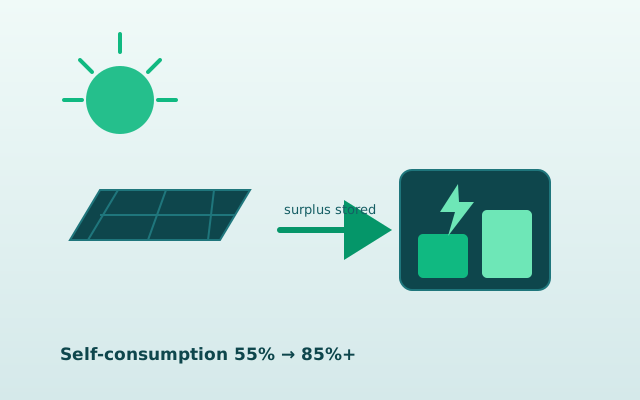
Typical solar-plus-storage system
- Energy capacity
- 100–500 kWh
- Power rating
- 50–250 kW
- C-rate
- 0.5C
- Round-trip efficiency
- 89%
- Cycle warranty
- 6,000 cycles / 10 years
- Typical project value
- £45,000–£220,000
- Simple payback
- 7 years
- Typical annual saving
- £18,000–£90,000/year
Value streams: Solar self-consumption uplift (55% → 85%+) · Avoided low-value export · Evening/weekend bill cover · DUoS peak avoidance
Standards & compliance: AC- or DC-coupled retrofit; G99 variation if the original PV was G98/G99. MCS-certified install supports any associated solar SEG registration.
Designed to PAS 63100 and the IET Code of Practice for EESS · BS EN 62619 cells / BS EN 62933 system · G99 connection (G100 export limitation where required).
Why this use case matters for UK businesses
A commercial solar array generates most of its power in the middle of the day, which is rarely when a business needs it most. On a typical site, demand peaks in the morning before production ramps up and again in the late afternoon and evening once the array has stopped producing. The result is that a large share of the generation is exported to the grid for a low Smart Export Guarantee (SEG) rate of 4-15p/kWh, while the same business buys power back later at a peak unit rate of 25-45p/kWh.
A behind-the-meter battery closes that gap. It stores surplus midday generation and releases it when the array is idle, so the energy your panels produce offsets the units you would otherwise import at full price. For most commercial PV installations, self-consumption sits at around 55% without storage. Adding a correctly sized battery lifts that to 85% or more, which is where the economics of solar-plus-storage become compelling.
This is not solar panel installation. It is the storage layer that makes an existing or planned commercial array pay back faster. If you already have PV, a battery is usually the single most effective upgrade you can make to its returns. For more on whole-project costs across system sizes, see our cost guide.
How the battery does it (the mechanism, referencing half-hourly load)
Every commercial site with a half-hourly (HH) meter generates a settlement-grade record of consumption in 48 daily readings. Overlay your solar generation profile on that HH demand curve and the opportunity becomes visible: a midday block where production exceeds on-site load, flanked by morning and evening periods where load exceeds production.
The battery is dispatched against exactly this picture. During the midday surplus, instead of exporting at the SEG rate, the system charges from the array. As production tails off in the afternoon and on-site demand rises into the evening, the battery discharges to cover that load. In economic terms it converts 4-15p/kWh of avoided low-value export into 25-45p/kWh of avoided import. That arbitrage between export value and import cost, repeated daily, is the core return.
Two coupling methods are available. A DC-coupled battery sits on the same side as the panels and shares an inverter, which is efficient for new builds. An AC-coupled battery connects on the building side and retrofits to existing PV regardless of the original inverter, which is the more common arrangement when storage is added later. We model both from your HH data and recommend whichever delivers the better round-trip economics for your specific load and array.
The same stored energy also covers weekend and bank-holiday baseload, when many sites still draw power but generation is poorly timed against occupancy, and it can be scheduled to avoid the most expensive Distribution Use of System (DUoS) red-band periods on weekday evenings.
Sizing and economics (power vs energy; what drives cost)
A battery is sized in two dimensions, and both matter. Power, measured in kW, is how fast it can charge or discharge. Energy, measured in kWh, is how much it can hold. For solar-plus-storage the energy figure usually leads, because the job is to soak up a midday surplus and release it over several evening hours.
For this use case we typically design systems of 100-500 kWh of energy and 50-250 kW of power, running at a 0.5C rate, meaning the battery charges or discharges its full capacity over roughly two hours. Round-trip efficiency is around 89%, so about 89% of the solar energy you store comes back out as usable power. Cells are lithium iron phosphate (LFP), chosen for thermal stability and cycle life, with a cycle warranty of 6,000 cycles over 10 years, typically to around 70% retained capacity.
Typical project value runs £45,000-£220,000 depending on size and coupling. Commercial-scale storage costs in the region of £200-450 per kWh, falling towards £140-240 per kWh on larger containerised systems; prices have dropped from around £800/kWh in 2020. What drives cost is energy capacity first, then power rating, coupling method, switchgear and protection, any DNO works, and the complexity of integrating with existing PV.
Simple payback for solar-plus-storage is around 7 years, with a typical annual saving of £18,000-£90,000 depending on array size, tariff, and how much generation was previously being exported. Payback is achieved by stacking savings, not relying on one: self-consumption uplift, avoided low-value export, evening and weekend bill cover, and DUoS peak avoidance.
Capital allowances improve the picture. The £1m Annual Investment Allowance (AIA) lets a business deduct 100% of qualifying cost against profits in the first year. Note that batteries are special-rate plant and machinery, so they do not qualify for 100% Full Expensing; spend above the £1m AIA attracts a 50% First-Year Allowance instead. Commercial battery storage is standard-rated at 20% VAT, which a VAT-registered business recovers in full. The 0% VAT relief applies only to domestic and charitable buildings, not commercial installations. Funding routes are set out on our grants and funding page.
A worked example
Consider a mid-sized manufacturing unit with a 250 kWp rooftop array installed three years ago. Its HH data shows strong daytime production but only about 56% self-consumption, with the remaining generation exported at 6p/kWh while the site imports evening and early-morning power at 32p/kWh. Annual import is just under 500,000 kWh.
We model a 300 kWh / 150 kW AC-coupled retrofit at a 0.5C rate. The battery captures the midday surplus that was being exported and redeploys it across the evening shift and into the following morning. Self-consumption rises from 56% to around 86%. Each kWh that previously earned 6p of export now avoids 32p of import, a 26p swing repeated daily, alongside DUoS red-band avoidance on weekday evenings.
The combined effect, savings stacked across self-consumption uplift, avoided export, evening bill cover, and peak DUoS avoidance, lands at roughly £42,000 a year. Against a project value near the middle of the £45,000-£220,000 range, simple payback comes out close to 7 years, before any capital-allowance benefit is applied. These figures are illustrative; we produce site-specific numbers from your own meter data. Request your modelled figures via our quote page.
Compliance and grid connection
A retrofit battery is a new generating and storage device on your connection, so it needs the right paperwork. Most commercial systems require a G99 application to your Distribution Network Operator (DNO); only the smallest devices fall under G98. If your original PV was connected under G98 or G99, adding storage usually triggers a G99 variation to the existing connection rather than a fresh application. Timescales run from 8 weeks to 12 months, so we submit early.
The DNO may impose export limitation or require an Active Network Management (ANM) connection, restricting how much you can export. For solar-plus-storage this is rarely a problem, because the battery’s purpose is to keep energy on site rather than push it to the grid; export limitation often makes storage more valuable, not less.
Systems are designed to the IET Code of Practice for Electrical Energy Storage Systems and to BS EN/IEC 62933 and IEC 62619, with proper fire, thermal, detection and separation design. Work is managed under CDM 2015, and your insurer is engaged before energisation. Use an MCS-certified installer for battery storage: it also supports SEG registration for any associated solar export. Check NICEIC, RECC or TrustMark registration and an insurance-backed workmanship warranty before you sign.
A further benefit worth noting: because a behind-the-meter battery lets you draw more during peaks than your agreed import capacity, it can support added load, EV chargers, plant or extra shifts, without a costly DNO reinforcement. If that is your priority, our EV charging and storage and peak-shaving pages go into more detail.
Who it suits, and who it doesn’t
Solar-plus-storage suits businesses that already run a commercial PV array and are exporting a meaningful share of generation at a low SEG rate, or that are installing solar now and want to maximise its return from day one. It works best where there is a clear mismatch between when the sun produces and when the site consumes, such as offices, manufacturing and warehousing with strong evening or early-morning baseload.
It is a weaker fit where self-consumption is already high, for example a site that runs heavy daytime processes and uses almost everything the array produces in real time. With little surplus to store, a battery has less to do, and the case may rest more on resilience or grid-flexibility revenue than on solar arbitrage. It is also a poor fit if there is no PV and none planned; in that case energy arbitrage on overnight tariffs or pure peak-shaving may be the better starting point.
We model from your half-hourly data before quoting, and if storage does not stack up against your specific load and tariff, we will tell you plainly rather than sell you a battery that will not earn its keep.
Frequently asked questions
Can I add a battery to solar panels that are already installed? Yes. An AC-coupled retrofit connects on the building side and works with existing PV regardless of the original inverter. Adding storage usually triggers a G99 variation to your existing DNO connection, which we handle as part of the project.
How much will a battery improve my solar self-consumption? On a typical commercial array, self-consumption rises from around 55% without storage to 85% or more with a correctly sized battery. The exact uplift depends on your generation profile and demand curve, which is why we model it from your half-hourly meter data first.
Does commercial solar battery storage qualify for 0% VAT? No. The 0% VAT relief applies only to domestic and charitable buildings. Commercial battery storage is standard-rated at 20% VAT, but any VAT-registered business recovers that in full, and the £1m Annual Investment Allowance lets you deduct the cost against first-year profits.
Retrofitting battery storage to an existing commercial solar array
Most storage projects now begin with an array that is already generating. A large stock of UK commercial PV went up when export payments were worth having and batteries cost several times what they do today, so the storage layer was left out. With cells now at £200-450/kWh and the import to export spread as wide as it has been, the retrofit is the default project shape. The roof, the connection and the generation are already there; only the economics of adding a battery energy storage system have moved.
On coupling, the honest default for a retrofit is AC. It leaves the existing inverter and its warranty untouched and lets you size the battery to your load, not the array. DC wins in narrower cases: where the inverter is hybrid-capable or due for replacement, or where an oversized array is clipping and that lost generation is worth capturing. The extra conversion step costs a little efficiency, but a well specified system still sits inside the 88-92% round-trip band.
Storage changes the registered capability of your connection, so the DNO has to be told. Where the original PV sat under G98, a commercial battery will almost always push the site into a full G99 application. Where it was already G99, the route is normally a variation to the existing agreement rather than a fresh connection. Applying G100 export limitation, which responds within about 15 seconds and 60 seconds at the outside, holds you to the capacity you already have and tends to get a variation approved faster. Allow 8 weeks to 12 months and treat it as the critical path.
Size from the export profile, not the headline kWp. What matters is the shape of the surplus: how many kWh actually leave the site in a given half hour, over how many hours, and how that changes between June and December. Pull twelve months of generation and half-hourly import data and read the spill directly; two sites with identical arrays can differ several times over. Set energy capacity against the weekday surplus you can redeploy the same evening, and power rating against the fastest spill rate plus any peak shaving duty the asset must also carry.
Storage does not end your SEG arrangement. The meter still records what is left, but you export less by design, so model the income you give up as a cost against the import you avoid. Check the tariff terms first, particularly any condition on grid-charged electricity being exported; charging from the array alone keeps that simple. Where the site can also earn from flexibility, grid services revenue through an aggregator is modelled separately and never guaranteed. Request a free feasibility study for the numbers on your own array.
See also
Model solar-plus-storage for your site
Send the postcode and your rough annual spend. We size the system for solar-plus-storage specifically and show whether the numbers work.
What you get, within 3 working days: a 2-page battery feasibility summary naming your indicative system size (kW and kWh), the installed cost band, which value streams actually apply to your site (peak-shaving, red-band DUoS avoidance, load shifting, solar self-consumption, grid services), and an honest payback range. If storage does not stack up for your site, the summary says so.
- We do not run a lead auction. Your details are never sold or passed to a panel of installers.
- No marketing list, no newsletter sign-up, no unsolicited calls.
- We will not oversize a system to inflate a quote, or model a payback we cannot defend.
Published by SEO Dons, a specialist commercial energy information network. We are independent: we are not an energy supplier and not a battery manufacturer.