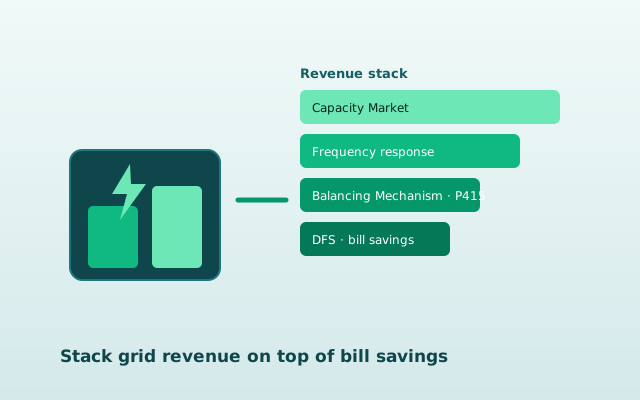
Typical grid services & revenue stacking system
- Energy capacity
- 500–2,000 kWh
- Power rating
- 250–1,000 kW
- C-rate
- 0.5C
- Round-trip efficiency
- 90%
- Cycle warranty
- 8,000 cycles / 12 years
- Typical project value
- £200,000–£900,000
- Simple payback
- 6 years
- Typical annual saving
- £60,000–£300,000/year
Value streams: Capacity Market agreements · Frequency response (Dynamic Containment/Moderation/Regulation) · Balancing Mechanism via P415 aggregator · Demand Flexibility Service (DFS)
Standards & compliance: Aggregator/route-to-market contract; metering to the relevant market's settlement standard. Capacity Market pre-qualification and (for BM) P415-compliant Balancing Mechanism Unit registration.
Designed to PAS 63100 and the IET Code of Practice for EESS · BS EN 62619 cells / BS EN 62933 system · G99 connection (G100 export limitation where required).
Why this use case matters for UK businesses
Most commercial battery projects pay for themselves on bill savings alone: peak-shaving, energy arbitrage and lifting solar self-consumption. Grid services are the layer on top. For a larger site that can spare some of its battery’s capacity, the electricity system will pay you to keep that capacity available and to respond when the grid is short. Done properly, this can add £20,000 to £100,000 or more per year to a single asset.
This is revenue, not a grant. National Energy System Operator (NESO) and the wider market buy flexibility because the grid needs fast-responding assets to balance an increasingly renewable system. A battery that can charge and discharge in seconds is well suited to that job. But the income is site-specific, it depends on which markets you can access and how you bid, and it is never guaranteed. Prices in frequency response and the Balancing Mechanism move with supply and demand, and a service that is lucrative one quarter can soften the next.
The honest framing is this: build the project so it stands up on bill savings, then treat grid revenue as upside that shortens payback rather than the reason to invest. A system designed only for trading income, with no on-site benefit, is exposed if those markets cool. Stacking grid revenue onto solid demand-side savings is what gets a larger asset to a simple payback around six years. See our cost breakdown for how the capital figures work, and where grid-flexibility and other funding routes sit alongside them.
How the battery does it
Everything starts with your half-hourly meter data. We model a full year of your half-hourly import and export to see your demand shape, your existing peak-shaving and arbitrage headroom, and crucially how much battery capacity is left over once those on-site jobs are done. Grid services only use the capacity your site is not already calling on.
That spare capacity is then made available to the market through an aggregator, sometimes called an optimiser or route-to-market provider. The aggregator pools your battery with others, forecasts prices, and bids your asset into the most valuable market each settlement period. In practice the same battery moves between jobs through the day:
- Capacity Market. You hold capacity available to deliver during system stress events and get paid an annual fee per kilowatt of de-rated capacity, won in a competitive auction. It is steady, contracted income that underpins the stack.
- Frequency response. Fast services such as Dynamic Containment, Dynamic Moderation and Dynamic Regulation pay the battery to nudge its charge or discharge up and down within seconds to hold grid frequency near 50 Hz. This rewards the battery’s speed and is often the highest-value daily service.
- Balancing Mechanism. Through a P415-registered aggregator, your battery can be dispatched as a Balancing Mechanism Unit, with NESO buying or selling power from it in real time to balance the system.
- Demand Flexibility Service (DFS). During tight winter periods, you can be paid to shift or shed load, which your battery does by discharging instead of importing.
The optimiser decides minute by minute whether the battery earns more by shaving your own peak, arbitraging the wholesale spread, or sitting in a frequency-response contract. You keep the bill savings; the grid revenue is shared with the aggregator under your route-to-market contract. If you also run energy arbitrage or peak-shaving, those streams are scheduled around the grid-service commitments rather than competing with them.
Sizing and economics
Grid services reward both how much power you can move and for how long, so the battery is sized on two axes. For this use case we typically design 500 to 2,000 kWh of energy paired with 250 to 1,000 kW of power, running at around 0.5C — meaning a battery can deliver its rated power for roughly two hours. Round-trip efficiency is about 90%, and the cells carry an 8,000-cycle / 12-year warranty, which matters when the asset is cycling hard for daily trading.
Power rating drives access to fast frequency services and sets your Capacity Market and Balancing Mechanism bid size. Energy capacity determines how long you can sustain a response and how much arbitrage and peak-shaving you can do alongside. A 1 MW / 2 MWh asset can hold a meaningful frequency-response position and still cover the site’s peaks; a smaller 250 kW / 500 kWh battery participates but earns proportionally less.
Whole-project value for this band runs £200,000 to £900,000, in line with the wider commercial range of £200 to £450 per kWh, falling toward £140 to £240 per kWh on larger containerised systems. Cost is driven by power electronics (inverters scale with kW), cell count (kWh), the DNO connection and any export limitation or Active Network Management equipment, switchgear, and metering to settlement standard. Batteries are special-rate plant and machinery: the £1m Annual Investment Allowance lets you deduct 100% of qualifying spend in year one, with a 50% First-Year Allowance on spend above that. Commercial battery storage is standard-rated at 20% VAT, recoverable in full by a VAT-registered business — the 0% relief applies to domestic and charitable buildings only. With bill savings plus stacked grid revenue, typical annual benefit lands at £60,000 to £300,000, for a simple payback near six years.
A worked example
Consider an unnamed Midlands cold-storage and distribution operator on a high-load half-hourly supply, paying steep red-band charges and exposed to peak unit rates of 25 to 45p/kWh. We modelled twelve months of their half-hourly data and specified an 800 kW / 1,600 kWh containerised LFP system at a project value of about £620,000.
On-site, the battery shaves the site’s evening peaks and runs overnight-to-daytime arbitrage, saving roughly £135,000 a year on demand and capacity charges and energy costs. The spare capacity is then bid into the grid by an aggregator: a Capacity Market agreement, a frequency-response position most weekdays, and Balancing Mechanism availability through a P415 route-to-market contract. Across a representative year that grid stack adds around £90,000, though we make clear that figure moves with market prices and is not contracted beyond the Capacity Market fee.
Combined, the asset returns roughly £225,000 a year, putting simple payback under three years once first-year AIA tax relief is counted, and comfortably inside six on a conservative grid-revenue assumption. The operator also gained headroom to add chilled-storage capacity without a DNO reinforcement, because the battery covers the extra peak draw behind the meter. We quote this kind of build at a fixed price within seven working days of receiving the data — request a quote to see your own numbers.
Compliance and grid connection
A grid-services battery in this size band is a G99 connection, submitted to your DNO. The G99 process can take anywhere from eight weeks to twelve months, so we submit early — it is often the longest item on the programme. The DNO may impose an export limitation scheme or require an Active Network Management connection that curtails export when the local network is constrained; we design to whatever terms come back and configure the inverters accordingly. Trading still works behind an export limit because the most valuable services use the battery’s response capability, not unlimited export.
On top of the connection, market access carries its own requirements. The asset needs metering to settlement standard, Capacity Market pre-qualification before any auction, and registration as a P415-compliant Balancing Mechanism Unit through your aggregator. The route-to-market contract sets out revenue shares, dispatch rights and minimum availability.
Everything is engineered to the IET Code of Practice for Electrical Energy Storage Systems and to BS EN/IEC 62933 and IEC 62619. That means proper fire, thermal, detection and separation design around the LFP enclosure, full CDM 2015 management on site, and your insurer engaged before energisation rather than after. Before you sign, confirm the installer quoting for the work holds MCS certification for battery storage plus NICEIC, RECC or TrustMark registration, and that the workmanship warranty is insurance-backed rather than a company promise.
Two gates that decide whether any of this is available to you
Most writing about revenue stacking describes grid-scale assets — a standalone battery on its own connection, built to trade. If your battery sits behind your meter, on your existing supply, two constraints decide which of these revenue streams you can actually reach. Check both before you model a penny of income, because either one can close a stream off entirely.
Your export limit. A behind-the-meter battery is connected under a G99 agreement with your DNO, and many commercial connections are granted with export limitation applied under G100 — the battery is allowed to discharge to serve your own load, but the amount it may push back onto the network is capped, sometimes at zero. That distinction is decisive. Services that pay you to reduce import — peak shaving against red-band DUoS, avoided available-capacity charges, and demand-turn-down products — work perfectly well on an export-limited site. Services that require you to export power on instruction do not: if the connection will not let the energy out, the asset cannot deliver against the instruction, however well specified it is. Read your connection agreement for the export limit before you read anyone’s revenue projection, and if you intend to trade, treat lifting that limit as part of the project rather than an afterthought — a variation to an existing G99 agreement takes time and may trigger reinforcement costs.
Your warranty’s throughput allowance. Stacking revenue means cycling the battery harder, and a commercial battery warranty is not open-ended. Cover is typically expressed as a total energy throughput (an MWh figure over the term) or an equivalent full-cycle count, alongside a retained- capacity guarantee — commonly a floor the cell must still meet at end of term. Standard behind-the- meter duty of roughly one cycle a day sits comfortably inside that. A stacked strategy that adds arbitrage and frequency response on top can push you towards two or more cycles a day, and at that rate the throughput allowance is consumed in a fraction of the time. The revenue may still be worth it — often it is — but the calculation is not simply the extra income. It is the extra income minus the accelerated degradation, and minus the risk of trading your way out of warranty cover in year six. Ask your supplier to state the warranty in MWh of throughput rather than years, then divide it by the throughput your proposed strategy actually implies. If nobody will put that arithmetic in writing, that is your answer about the strategy.
Neither of these is a reason to avoid revenue stacking. They are the two questions that separate a revenue model that survives contact with your site from one that reads well in a proposal. Note too that the rates themselves — Capacity Market clearing prices, frequency-response and Balancing Mechanism revenues — move continuously with each auction and settlement period, so treat any per-MW figure you find online, including in the sources ranking above this page, as a snapshot rather than a forecast.
Who it suits — and who it doesn’t
This use case suits larger sites with a genuine half-hourly supply, a sizeable agreed import capacity, and demand patterns that leave room for the battery to take on grid work — typically manufacturing, cold storage, logistics, data and large commercial estates. It works best where there is already a solid bill-saving case from peak-shaving or arbitrage, because grid revenue then sharpens an already-sound investment. Sites with on-site PV can layer this on top of solar self-consumption as well.
It does not suit smaller sites where the battery’s whole capacity is consumed by on-site savings, leaving nothing to offer the grid. It is the wrong fit for any business that wants guaranteed, fixed returns: frequency-response and Balancing Mechanism income is variable by design, and we will not pretend otherwise. If your modelling shows grid revenue is the only thing making a project work, the project is too fragile — we would tell you so and steer you to a smaller, demand-led system instead.
Frequently asked questions
Is grid-services revenue guaranteed? No. The Capacity Market fee is contracted once you win an auction, but frequency response and Balancing Mechanism income vary with live market prices and dispatch. We model conservatively and design every project to pay back on bill savings first, treating grid revenue as upside.
Do I need an aggregator? For practical purposes, yes. Markets such as the Balancing Mechanism require P415 registration and settlement-standard metering, and bidding into frequency response daily needs a 24/7 optimiser. An aggregator handles registration, forecasting, bidding and dispatch under your route-to-market contract.
Can I still earn grid revenue if the DNO limits my export? Yes. The highest-value services reward the battery’s fast response and its ability to vary import, not unlimited export, so an export limitation or Active Network Management connection still leaves a strong stack of Capacity Market, frequency response and demand-side income intact.
What revenue stacking means for a UK commercial battery
Revenue stacking means one battery earning from several income streams rather than a single one: on-site bill savings plus payments from the electricity system. A UK behind-the-meter battery can shave site peaks, shift load, hold a Capacity Market agreement and sit in frequency response. Those streams are layered across the day, not all delivered in the same second.
The stack has two halves. The demand-side half is yours alone and needs no market access: avoiding red-band DUoS half-hours through peak shaving, load shifting on a time-of-use tariff, and lifting solar self-consumption from roughly 55% to 85% or better. That half alone typically cuts the bill by 10% to 30% before any market revenue. The Triad regime has ended and network charging is now banded, so the saving comes from avoiding red half-hours rather than three winter peaks.
| Stream | What it pays for | How it stacks |
|---|---|---|
| Peak shaving, red-band avoidance | Lower measured demand and DUoS charges | Always first call on the battery |
| Load shifting, arbitrage | The spread between cheap and expensive half-hours | Fills spare cycles around commitments |
| Solar self-consumption | Using your own generation instead of exporting it | Charges the battery when PV is spilling |
| Capacity Market | Holding de-rated capacity available for stress events | Annual fee, delivery only when called |
| Frequency response (DC, DM, DR) | Holding headroom and responding within seconds | Reserves kW for the contracted window |
| Balancing Mechanism (P415 aggregator) | Real-time instructions to import or export | Bid only in uncommitted periods |
| Demand Flexibility Service | Shifting or shedding load in tight winter periods | Overlaps well with evening peak shaving |
What cannot be stacked is the same kilowatt in two places at once. If 400 kW is committed to Dynamic Containment for a four-hour window, it is not available to cut your own peak in that window and cannot also be bid into the Balancing Mechanism. Energy is the second limit: a 250 kW / 500 kWh system is a two-hour asset, so a deep site peak and a long market call cannot both be served from one charge. The optimiser picks the highest-value job each settlement period, which is why stacking is a scheduling exercise rather than simple addition.
Stacking is what moves payback towards the short end of the four to ten year range, but the outcome is site-specific and never guaranteed. Only the Capacity Market fee is contracted once won; frequency response and Balancing Mechanism prices move with the market. We are independent of suppliers and manufacturers, so the modelling favours no route to market. Check the demand-side case against real commercial battery storage cost figures first, then book a free feasibility review of twelve months of half-hourly data to see which streams your site can reach.
See also
Model grid services & revenue stacking for your site
Send the postcode and your rough annual spend. We size the system for grid services & revenue stacking specifically and show whether the numbers work.
What you get, within 3 working days: a 2-page battery feasibility summary naming your indicative system size (kW and kWh), the installed cost band, which value streams actually apply to your site (peak-shaving, red-band DUoS avoidance, load shifting, solar self-consumption, grid services), and an honest payback range. If storage does not stack up for your site, the summary says so.
- We do not run a lead auction. Your details are never sold or passed to a panel of installers.
- No marketing list, no newsletter sign-up, no unsolicited calls.
- We will not oversize a system to inflate a quote, or model a payback we cannot defend.
Published by SEO Dons, a specialist commercial energy information network. We are independent: we are not an energy supplier and not a battery manufacturer.