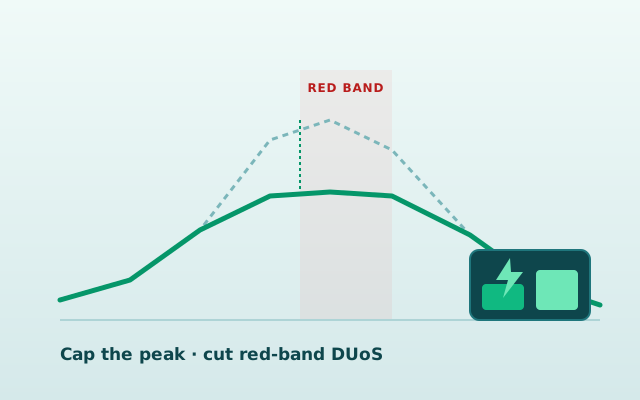
Typical peak shaving & demand management system
- Energy capacity
- 200–1,000 kWh
- Power rating
- 100–500 kW
- C-rate
- 0.5C
- Round-trip efficiency
- 90%
- Cycle warranty
- 6,000 cycles / 10 years
- Typical project value
- £90,000–£450,000
- Simple payback
- 6 years
- Typical annual saving
- £30,000–£150,000/year
Value streams: Red-band DUoS avoidance · Available-capacity (kVA) charge reduction · Peak unit-rate avoidance · Triad/demand-charge management
Standards & compliance: G99 application for the BESS; DNO may apply an export/import limitation scheme. Available-capacity (kVA) renegotiation with the supplier once peak demand falls.
Designed to PAS 63100 and the IET Code of Practice for EESS · BS EN 62619 cells / BS EN 62933 system · G99 connection (G100 export limitation where required).
Why this use case matters for UK businesses
For most commercial sites, the expensive electricity is not the average unit it is the peak. A spiky daytime load drives up three separate charges at once. The red-band Distribution Use of System (DUoS) rate applies to every unit drawn across the late-afternoon peak. The available-capacity charge bills you on the agreed import capacity (kVA) you reserve, whether you use it or not. And the peak unit rate itself can sit anywhere between 25p and 45p/kWh on a half-hourly contract. Trim the height of your demand curve at the worst hours and all three charges fall together.
Peak shaving uses a behind-the-meter battery to do exactly that. The battery discharges during the costly window so the meter sees a lower, flatter draw, then recharges when power is cheap. Nothing about your production changes, the machines run as before. What changes is the shape of demand the grid sees, and that shape is what your bill is built on.
There is a second, often larger prize. A constrained site that is bumping against its agreed import capacity can use a battery to draw more power during peaks than the grid connection alone would allow, because the battery supplies the difference. That lets a business add EV chargers, new plant, or an extra shift without paying for a costly DNO reinforcement. Deferring or avoiding that upgrade frequently dwarfs the unit-rate savings. See our cost breakdown for how these streams combine.
How the battery does it
Everything starts with your half-hourly meter data. Any business on a maximum-demand or half-hourly settled supply has it, and it is the single most important input we have. We pull twelve months of half-hourly readings and build a load profile that shows exactly when your demand peaks, how high it climbs, how predictable those peaks are, and how long they last.
A typical manufacturing or process site shows a recognisable signature: a sharp morning ramp as plant starts up, a sustained daytime plateau, and demand spikes when several large loads coincide. The expensive part is the weekday evening peak, broadly 16:00 to 19:00, when red-band DUoS and the highest unit rates land at the same time. The battery is programmed to discharge across that window, shaving the top off the demand curve so the grid never sees your true maximum.
The control system watches demand in real time and holds the metered draw below a target threshold, releasing stored energy whenever the site would otherwise breach it. Outside the peak, when power is cheapest overnight or in the small hours, it recharges ready for the next day. Because the peaks on a process site are usually predictable, the same pattern repeats day after day, which is what makes the saving bankable rather than speculative. Where the modelling shows the numbers do not stack up, we will tell you, that honesty is the point of working from real data rather than averages.
Sizing and economics
A storage system is sized on two numbers, not one. Power, measured in kW, is how hard it can push, it sets how much you can shave off an instantaneous peak. Energy, measured in kWh, is how long it can sustain that push. A 250 kW / 500 kWh system is a “2-hour” battery: it can hold 250 kW of shaving for two hours before it is empty. Get either dimension wrong and the saving disappears, too little power and you cannot flatten the spike, too little energy and the battery runs flat before the peak ends.
For peak shaving the typical envelope is 200 to 1,000 kWh of energy and 100 to 500 kW of power, run at around a 0.5C rate so the cells discharge gently over roughly two hours. We design around lithium iron phosphate (LFP) cells for their thermal stability and long cycle life, with round-trip efficiency near 90% and a warranty of about 6,000 cycles or 10 years to roughly 70% retained capacity. Project values for this use case run £90,000 to £450,000, and typical annual savings land between £30,000 and £150,000, for a simple payback near 6 years.
What moves the cost? Scale is the biggest lever, larger containerised systems fall toward £140-£240/kWh while smaller commercial builds sit at £200-£450/kWh. Then there is the electrical infrastructure: switchgear, the G99 connection works, civils and any DNO requirements. The economics improve sharply when several value streams stack, peak-rate avoidance, red-band DUoS, the kVA charge reduction and, where it applies, a deferred capacity upgrade. A battery sized purely for peak shaving can often also earn grid-flexibility revenue in the hours it would otherwise sit idle.
A worked example
Consider an unnamed Midlands plastics manufacturer on a half-hourly supply with a 600 kVA agreed import capacity. Its load profile shows a steep weekday plateau and recurring spikes to about 540 kW when extrusion lines and chillers run together, almost all of it inside the 16:00 to 19:00 red band. The site wanted to add a second injection-moulding cell, which would have pushed peak demand past its agreed capacity and triggered a DNO reinforcement quoted in the low six figures with a long lead time.
We modelled a 300 kW / 600 kWh LFP system, a project value of about £210,000. Programmed to hold metered demand below roughly 450 kW across the peak, the battery shaves around 90-150 kW off the worst half-hours every weekday. The savings stack: lower red-band DUoS, reduced peak unit consumption at around 35p/kWh, and, once peak demand is reliably suppressed, a renegotiated kVA agreement cutting the available-capacity charge. Combined, these came to roughly £36,000 a year, a simple payback around 6 years before any grid revenue.
The bigger win was strategic. By covering the new moulding cell’s contribution to peak demand from storage, the site added the load without the DNO reinforcement, avoiding the upgrade cost entirely and removing a multi-month delay. That avoided spend is not in the £36,000 figure, it made the project pay for itself faster than the unit savings alone suggest. Every figure here would be confirmed against the customer’s own half-hourly data before we issued a fixed-price quote.
Compliance and grid connection
A peak-shaving system of this size needs a full G99 application to the District Network Operator (G98 covers only the smallest installations). The DNO may grant the connection with an export or import limitation scheme, or require Active Network Management, and the G99 timescale runs anywhere from 8 weeks to 12 months, so we submit early. We design to the IET Code of Practice for Electrical Energy Storage Systems and to BS EN/IEC 62933 and IEC 62619, with full fire, thermal, detection and separation design, all under CDM 2015, and we engage your insurer before energisation.
One point specific to peak shaving: once the battery is reliably holding your maximum demand down, your agreed import capacity is likely larger than you now need. Renegotiating the agreed kVA downward removes excess available-capacity charges — a saving that continues every month for the life of the system, and one many businesses never claim. Confirm your installer is MCS-certified for battery storage and NICEIC, RECC or TrustMark registered.
Who it suits — and who it doesn’t
Peak shaving suits sites with a spiky, predictable daytime load: manufacturers, process plants, cold stores, and any operation where several large loads coincide inside the red-band window. It is at its most compelling where the site is also capacity-constrained, because deferring a DNO reinforcement adds a large saving on top of the unit-rate reductions. The more pronounced and repeatable your peaks, the better the case.
It is a weaker fit where demand is flat and predictable with no real peaks, there is little to shave, so the unit-rate saving is thin. Sites with a generous, under-used import capacity and modest peak charges may find the payback drifts past ten years. If your main objective is overnight cost-shifting rather than clipping spikes, energy arbitrage is the better-matched strategy, and where resilience is the priority, backup power and resilience should lead the design. We will always model your half-hourly data first and tell you honestly if storage does not stack up for your site.
Frequently asked questions
How much can peak shaving actually cut off our bill? For a well-matched process site, typical annual savings run £30,000 to £150,000, drawn from red-band DUoS avoidance, lower peak unit consumption and a reduced kVA charge. The exact figure depends entirely on the shape of your peaks, which is why we model from twelve months of your own half-hourly meter data before quoting.
Can a battery really help us avoid a DNO capacity upgrade? Yes. Because the battery supplies the extra power during peaks, a behind-the-meter system lets a constrained site draw more during peak periods than its agreed import capacity, so you can add EV chargers, plant or shifts without a costly grid reinforcement. The avoided upgrade is often the single largest part of the business case.
Does commercial peak-shaving storage qualify for 0% VAT? No. Commercial battery storage is standard-rated at 20% VAT, though any VAT-registered business recovers it in full. The 0% VAT relief applies only to domestic and charitable buildings (until 31 March 2027). On the capital allowances side, the Annual Investment Allowance lets you deduct 100% of the cost in year one up to £1m, with a 50% First-Year Allowance on spend above that.
What a peak shaving service includes, and how to judge a peak shaving supplier
A peak shaving service is an engineering and control contract, not a battery sale. It covers twelve months of half-hourly data analysis, an agreed target peak, an EMS control strategy tuned to red-band DUoS half-hours, the G99 application and any G100 limitation scheme, and support to renegotiate your agreed import capacity once measured peak demand falls.
Five workstreams separate a service from a supply-only quote. Data analysis sets the target peak from your own consumption rather than a rule of thumb. Control strategy defines what the energy management system does in every half-hour, including which peaks it defends. Scheduling maps discharge onto the red DUoS band and recharge onto the cheapest hours, because the Triad regime has ended and the value now sits in avoiding red-band half-hours rather than three winter peaks. Grid compliance covers the G99 application, usually the critical path at 8 weeks to 12 months, plus G100 import or export limitation where the DNO asks for it, responding within roughly 15 seconds. Commercial follow-through means going back to the supplier and the DNO to cut the billed kVA once the lower peak is proven in the data.
| Ask a supplier | A real service answers | A box sale answers |
|---|---|---|
| How was the size chosen? | From twelve months of half-hourly data, sized on kW and kWh separately | From a headline bill figure or an annual kWh total |
| What target peak will you hold? | A stated kW threshold, and the half-hours it defends | ”It will reduce your peaks” |
| Who submits the G99? | We do, early, with the DNO timeline inside the programme | ”Your electrician can handle that” |
| What happens after commissioning? | Performance reporting, control retuning, kVA renegotiation | Warranty contact details |
| Whose equipment is it? | Chosen per site, LFP cells, 88 to 92% round-trip efficiency | One brand, every time |
Three things give a box sale away. The quote leads with a price per kWh instead of a target peak in kW. Flexibility income is quoted as a fixed annual number rather than as site-specific and never guaranteed. And nobody has asked for your half-hourly data before pricing the job.
We are independent of suppliers and manufacturers, so the specification follows your load profile, not a stock list. Start with the commercial battery storage cost ranges, then the design detail behind a battery energy storage system, and what the idle hours can earn through grid services revenue. If you can send half-hourly data, book a free feasibility and we will model the target peak before anyone talks about hardware.
See also
- commercial power backup in Milton Keynes
- battery storage installation across Nottinghamshire
- commercial solar battery storage in Hampshire
Model peak shaving & demand management for your site
Send the postcode and your rough annual spend. We size the system for peak shaving & demand management specifically and show whether the numbers work.
What you get, within 3 working days: a 2-page battery feasibility summary naming your indicative system size (kW and kWh), the installed cost band, which value streams actually apply to your site (peak-shaving, red-band DUoS avoidance, load shifting, solar self-consumption, grid services), and an honest payback range. If storage does not stack up for your site, the summary says so.
- We do not run a lead auction. Your details are never sold or passed to a panel of installers.
- No marketing list, no newsletter sign-up, no unsolicited calls.
- We will not oversize a system to inflate a quote, or model a payback we cannot defend.
Published by SEO Dons, a specialist commercial energy information network. We are independent: we are not an energy supplier and not a battery manufacturer.