Typical energy arbitrage & time-of-use system
- Energy capacity
- 215–860 kWh
- Power rating
- 100–430 kW
- C-rate
- 0.5C
- Round-trip efficiency
- 90%
- Cycle warranty
- 8,000 cycles / 12 years
- Typical project value
- £85,000–£380,000
- Simple payback
- 6 years
- Typical annual saving
- £28,000–£130,000/year
Value streams: Off-peak to peak arbitrage on a time-of-use tariff · Wholesale/day-ahead price spread capture · Red-band DUoS avoidance
Standards & compliance: Requires a half-hourly meter and ideally a time-of-use or pass-through tariff. Energy Management System (EMS) optimises the charge/discharge schedule against forward prices.
Designed to PAS 63100 and the IET Code of Practice for EESS · BS EN 62619 cells / BS EN 62933 system · G99 connection (G100 export limitation where required).
Why this use case matters for UK businesses
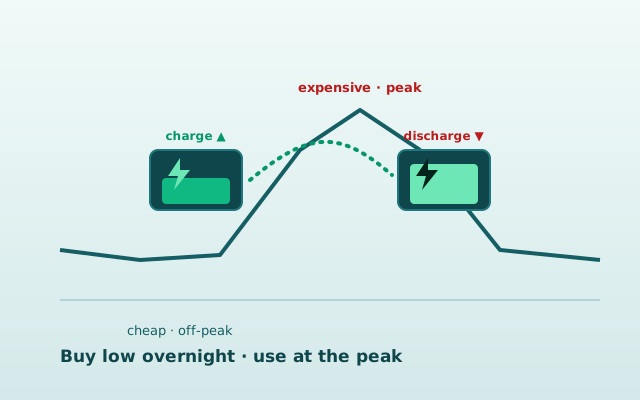
The gap between off-peak and peak electricity prices is the single most reliable margin a commercial battery can capture. Overnight or off-peak power can cost a fraction of the daytime rate, while peak unit rates sit at 25-45p/kWh once red-band Distribution Use of System (DUoS) charges and supplier margins are loaded on. Energy arbitrage is the practice of buying electricity when it is cheap, storing it, and using it when it is expensive — turning the difference into a saving on every cycle.
For a business on a time-of-use or half-hourly pass-through tariff, that spread is not theoretical. It is printed on your bill every day. A behind-the-meter battery lets you exploit it without changing how the site operates: the plant runs as normal, but a growing share of its daytime demand is served by power bought hours earlier at a lower price.
Arbitrage works best as one of several stacked value streams rather than a standalone case, but for sites with the right tariff and a steady daily load it can be the largest single contributor. It pairs naturally with peak-shaving, which trims your highest demand spikes, and with solar self-consumption where panels are already on the roof. We will tell you honestly whether the spread on your tariff justifies the capital before you commit a penny.
How the battery does it (the mechanism)
The mechanism is straightforward, and it lives in your half-hourly meter data. Every settlement period — there are 48 per day — your meter records consumption. We overlay your tariff’s time bands on that profile to find the cheap windows and the expensive ones.
During the cheap window, typically overnight, the Energy Management System (EMS) charges the battery from the grid. As the tariff steps up into the daytime peak, the EMS stops importing and discharges the stored energy to serve site load instead. The meter sees less grid import precisely when each unit is most expensive. On a day/night tariff the bands are fixed; on a half-hourly pass-through tariff the EMS can optimise against forward day-ahead prices, charging deeper before a forecast price spike and holding back when the spread is thin.
A full discharge each day is what makes the economics work. The battery is sized so its energy capacity (kWh) roughly matches the load you can shift out of the peak window, and its power rating (kW) is enough to cover that load while it discharges. A 250 kW / 500 kWh system, for example, is a “2-hour” battery: it can deliver 250 kW for two hours. If your peak window is longer and flatter, you need more kWh relative to kW; if it is short and sharp, you need more kW. We model both from your data so the battery is neither starved nor oversized.
Sizing and economics
Arbitrage systems for this use case typically run from 215 kWh to 860 kWh of energy capacity, with power ratings of 100-430 kW — a 0.5C design, meaning the battery charges or discharges over roughly two hours. Round-trip efficiency is around 90%, so for every 100 kWh drawn from the grid overnight, about 90 kWh is available to discharge the next day; the EMS factors that loss into whether a given spread is worth cycling for. The cells are lithium iron phosphate (LFP), chosen for thermal stability and cycle life, warranted to 8,000 cycles or 12 years.
Typical project value lands between £85,000 and £380,000. Commercial-scale battery storage costs roughly £200-450 per kWh installed, falling toward £140-240 per kWh on larger containerised systems — well down from around £800/kWh in 2020. What drives the figure is the kW/kWh ratio (power electronics scale with kW; cells scale with kWh), the site’s electrical infrastructure, any switchgear or transformer work, and the DNO connection terms.
Typical annual saving runs £28,000-£130,000 depending on system size, the size of the off-peak-to-peak spread on your tariff, and how reliably you can fully cycle the battery each day. Simple payback is around 6 years. That is a stacked figure: arbitrage on the tariff spread, plus red-band DUoS avoidance, plus any wholesale day-ahead capture. On the tax side, the Annual Investment Allowance lets a business deduct 100% of qualifying spend up to £1m against profits in year one; batteries are special-rate plant and machinery, so spend above the AIA attracts a 50% First-Year Allowance rather than Full Expensing. The install is standard-rated at 20% VAT, recoverable in full by any VAT-registered business. See our cost guide for the full breakdown and grants and funding for where grid-flexibility revenue can stack on top.
A worked example
Consider a mid-sized cold-storage and distribution business in the Midlands on a half-hourly pass-through tariff. Its load is relatively flat — refrigeration runs around the clock — which makes it an ideal arbitrage candidate, because a flat load can absorb a full battery discharge every single day without waste.
The site installs a 320 kW / 640 kWh system, a project around £230,000. Each night the EMS charges the battery during the cheapest settlement periods. Through the daytime peak it discharges 640 kWh (about 576 kWh delivered after the 90% round-trip loss), displacing grid import priced at 30-40p/kWh and bought overnight at a fraction of that. Across roughly 320 full-cycle days a year, the tariff-spread saving alone is substantial; layering red-band DUoS avoidance and occasional deeper charging ahead of forecast price spikes lifts the total.
Combined annual saving lands around £55,000-£70,000. Against the £230,000 capital, with the AIA deducting the first £1m of spend in year one, simple payback comes in close to 6 years. The system is warranted to 8,000 cycles, so at one full cycle a day it has well over a decade of cycling headroom before reaching its end-of-warranty retained capacity. These figures are illustrative — your own numbers come from your half-hourly data, not a template. Request a fixed-price quote and we will model it.
Compliance and grid connection
A battery of this size is a grid-connected generator in the DNO’s eyes and needs a G99 application (only the smallest systems qualify for the simpler G98 route). G99 timescales range from 8 weeks to 12 months depending on the network area and available headroom, so we submit early. The DNO may impose an export limitation or require an Active Network Management (ANM) connection — for a pure arbitrage battery that charges and discharges behind the meter, export limitation is rarely a constraint, since the value is in avoided import rather than export.
Systems are designed to the IET Code of Practice for Electrical Energy Storage Systems and to BS EN/IEC 62933 and IEC 62619. That covers fire and thermal management, gas detection, and physical separation, with the installation run under CDM 2015 and your insurer engaged before energisation. Confirm your installer is MCS-certified for battery storage and NICEIC approved, and that the workmanship warranty is insurance-backed rather than a company promise.
One structural benefit worth flagging: because the battery discharges behind the meter, it lets the site draw more power during peaks than its agreed import capacity. That means you can often add EV chargers, plant, or extra shifts without paying for a costly DNO reinforcement — the battery covers the peak the grid connection cannot.
Who it suits — and who it doesn’t
Arbitrage suits businesses with a half-hourly meter, a time-of-use or pass-through tariff, and a flat or predictable daily load that can absorb a full discharge every day — cold stores, data-adjacent facilities, continuous-process manufacturing, and similar operations. The wider the off-peak-to-peak spread on your tariff, the stronger the case.
It suits you less well if your tariff is flat-rate with no meaningful day/night difference, because there is no spread to capture. It also struggles where the load is highly intermittent: a site that only draws heavily two days a week cannot cycle the battery often enough to earn its keep on arbitrage alone. In those cases peak-shaving, backup and resilience, or grid-services revenue may carry the business case instead. We model all of these from your data and tell you plainly if storage does not stack up — an honest no costs you nothing.
Frequently asked questions
Do I need a special tariff for arbitrage to work? You need a half-hourly meter and, ideally, a time-of-use or half-hourly pass-through tariff with a genuine gap between off-peak and peak prices. The wider that gap, the more each daily cycle saves. On a flat-rate tariff there is no spread to capture, so we would steer you toward a different value stream.
How does the battery know when to charge and discharge? An Energy Management System runs the schedule. On a fixed day/night tariff it charges in the cheap band and discharges in the peak. On a pass-through tariff it optimises against forward day-ahead prices, charging deeper before a forecast spike and easing off when the spread is thin.
Will daily cycling wear the battery out quickly? The LFP cells are warranted to 8,000 cycles or 12 years, typically to around 70% retained capacity. At one full cycle a day that is well over a decade of life, which is why these systems are sized for a single deep daily cycle rather than constant shallow ones.
Energy arbitrage vs peak shaving: what is the difference?
Peak shaving targets demand, measured in kW: it clips your costliest half-hours to cut red-band DUoS and available-capacity charges. Arbitrage targets price, measured in p/kWh: it buys cheap half-hours and discharges into expensive ones. One battery does both, and on most commercial sites the payback comes from running them together.
| Peak shaving | Energy arbitrage | |
|---|---|---|
| What it targets | Demand (kW) in your highest half-hours | The price spread (p/kWh) between half-hours |
| What it needs from the tariff | Banded DUoS plus an available-capacity (kVA) charge worth avoiding | A real off-peak to peak gap, ideally half-hourly pass-through |
| When it earns | Only in the handful of half-hours that set the charge | Every day the battery can complete a full cycle |
| Site profile that suits it | Spiky load: chillers, presses, welding, EV charging | Flat, predictable load that absorbs a full discharge daily |
| What caps it | How high your peaks actually are | The spread, minus 88-92% round-trip losses |
At the meter the two look identical, because in both cases import falls while the battery discharges. The difference is where the money comes from. Peak shaving is paid for by avoiding a charge levied on your maximum demand, so it can earn its keep in a few half-hours a month. Arbitrage is paid per unit shifted, so it needs volume and repetition. Since the Triad regime ended and charging moved to a banded DUoS structure, the demand-side prize is avoiding red-band half-hours rather than three winter evenings; the demand side of the case sets out how that is modelled.
They conflict at the point of dispatch. Charge held back for a forecast demand peak is charge you cannot sell into a price spread, and a battery emptied into a morning trade may be flat when the red band opens. The EMS resolves it by ranking the two: it reserves the state of charge needed to protect the demand target first, then trades whatever headroom is left against forward prices, and it will decline a thin spread rather than spend reserved capacity on it. That reservation is a sizing decision as much as a software one, which is why a commercial storage system is specified on power (kW) and energy (kWh) separately from your half-hourly data.
Stacked properly, one LFP system protects the demand target, trades the spread on the days it is worth trading, and can still be offered into flexibility market income through an aggregator, which is site-specific and never guaranteed. We are independent of suppliers and manufacturers, so if only one of the two modes pays on your site, we will say so plainly. Send us twelve months of half-hourly data and we will model both.
See also
- commercial battery storage systems in Northampton
- East Midlands demand profiles
- battery storage across Devon
Model energy arbitrage & time-of-use for your site
Send the postcode and your rough annual spend. We size the system for energy arbitrage & time-of-use specifically and show whether the numbers work.
What you get, within 3 working days: a 2-page battery feasibility summary naming your indicative system size (kW and kWh), the installed cost band, which value streams actually apply to your site (peak-shaving, red-band DUoS avoidance, load shifting, solar self-consumption, grid services), and an honest payback range. If storage does not stack up for your site, the summary says so.
- We do not run a lead auction. Your details are never sold or passed to a panel of installers.
- No marketing list, no newsletter sign-up, no unsolicited calls.
- We will not oversize a system to inflate a quote, or model a payback we cannot defend.
Published by SEO Dons, a specialist commercial energy information network. We are independent: we are not an energy supplier and not a battery manufacturer.